My newest publication, Echoes and Memories, is now available on Smashwords and Amazon. As per the usual cycle, it will soon trickle out from Smashwords to the various other retailers such as Kobo and Barnes and Noble.
In the end, I cut a couple of the stories from the collection as they simply weren't strong enough. One of those I hope to whip into shape and put in front of the public at a later date. The other I'm not sure about... it has potential as an idea, but as-is it just doesn't have enough substance to stand on its own. The concept may need to get folded into another story.
Anyway, the end result is that this collection comes in at around 30k words, which is about the minimum it had to be for me to think it could be published, even when the stories themselves are strong. I have half an intention to eventually publish an updated version which inserts a new story. Cuz I'm a self-publisher damnit, and I can do that.
As I was going through the publication process on this one, I saw that Smashwords now has a "publish for preorder" option where you can schedule a publication date in the future and open the book up to preorders. Might try that for the next book. Maybe by that time Amazon will have something similar for indie publishers.
Showing posts with label ePublishing. Show all posts
Showing posts with label ePublishing. Show all posts
Tuesday, August 12, 2014

Monday, July 2, 2012
Release Day: TWIXT HEAVEN AND HELL
TWIXT HEAVEN AND HELL is live on Smashwords and Amazon!
I've shown you the cover, and the cover copy (though that has been through some revisions), and talked about it plenty - and now it is out there in the world. Under the judgement of the public eye. As I've mentioned before, though, a poor reception for a self-published book really amounts to no reception at all. The book simply disapears into the depths of the internet, and never makes a splash.
I want to hear a splash, damnit. To that end I've prepared an audio trailer which I'll be trying to get onto various podcasts - fortunately, I have an ally at The Roundtable Podcast, and thus have one venue for the teaser already.
I would also like to thank the adventurous soul who was browsing Smashwords last night when my book first hit the New Releases homepage. Less than an hour after publication, somebody had downloaded the sample, liked what they saw, and purchased the book.
I am still blown away by how amazing that is.
Not merely the fact that somebody decided to buy my brand-new book on the strength of the sample (and, no doubt, the cover), but also by the logistics alone. I had pushed the button to publish only moments before, and then I had my first sale.
To whomever made that purchase, I hope you enjoy the book - and then I hope you tell your friends!
I've shown you the cover, and the cover copy (though that has been through some revisions), and talked about it plenty - and now it is out there in the world. Under the judgement of the public eye. As I've mentioned before, though, a poor reception for a self-published book really amounts to no reception at all. The book simply disapears into the depths of the internet, and never makes a splash.
I want to hear a splash, damnit. To that end I've prepared an audio trailer which I'll be trying to get onto various podcasts - fortunately, I have an ally at The Roundtable Podcast, and thus have one venue for the teaser already.
I would also like to thank the adventurous soul who was browsing Smashwords last night when my book first hit the New Releases homepage. Less than an hour after publication, somebody had downloaded the sample, liked what they saw, and purchased the book.
I am still blown away by how amazing that is.
Not merely the fact that somebody decided to buy my brand-new book on the strength of the sample (and, no doubt, the cover), but also by the logistics alone. I had pushed the button to publish only moments before, and then I had my first sale.
To whomever made that purchase, I hope you enjoy the book - and then I hope you tell your friends!
Wednesday, February 29, 2012
To Authors: Work on the those summaries
I knew for a month and a half that I was going to publish the story at the end of February.
I had a time-frame for initial revisions, beta-reading, and secondary revisions. I had target dates for getting cover art done and formatting done. Yet somehow I still waited until the night I published The Three Fingers of Death to write the story summary - you know, the little description field you see on Amazon or Smashwords.
Stupid, stupid, stupid me.
It's an old truth that many writers never really get the hang of writing succinctly. For those still pursuing the traditional publishing route (which I am) the mantra is 'cut, cut, cut'. Agents and authors will go on for pages (ironic, eh?) about the need to trim the fat out of your book. Stephen King had a rule of thumb he received from an editor at some magazine which went something like: "Final draft = first draft - 10%".
I'm not sure how I feel about the general pattern of 'cut everything that isn't essential.' I think a lot of that pressure came from traditional publishing's need to save money on printing costs and the general impatience that came from the industry being overburdened with too many wannabe authors and not enough time to wade through them. I'm okay with the odd paragraph of purple prose as long as it's a pleasant shade.
On the other hand, the story summary (or description, whatever you want to call it) is one place where the ability to write in a more taciturn manner comes very much in handy. Furthermore, you need to be able to use those few words to tease and tantalize the reader, hook them in exactly the way your opening pages should do (though if your story starts out slower, hooking them in the summary is a good avenue of attack!).
Needless to say, I will be re-writing the summary. Come to think of it, I need to do that for both my currently-available works, and I need to generally pay more attention to that aspect from now on. Especially in the self-publishing world, you can't afford to ever come off as an amateur. That summary is the first thing a reader sees of your book. You need to make it shine.
... and by you, I mean me.
(PS: The Three Fingers of Death now available on Amazon and Smashwords!)
I had a time-frame for initial revisions, beta-reading, and secondary revisions. I had target dates for getting cover art done and formatting done. Yet somehow I still waited until the night I published The Three Fingers of Death to write the story summary - you know, the little description field you see on Amazon or Smashwords.
Stupid, stupid, stupid me.
It's an old truth that many writers never really get the hang of writing succinctly. For those still pursuing the traditional publishing route (which I am) the mantra is 'cut, cut, cut'. Agents and authors will go on for pages (ironic, eh?) about the need to trim the fat out of your book. Stephen King had a rule of thumb he received from an editor at some magazine which went something like: "Final draft = first draft - 10%".
I'm not sure how I feel about the general pattern of 'cut everything that isn't essential.' I think a lot of that pressure came from traditional publishing's need to save money on printing costs and the general impatience that came from the industry being overburdened with too many wannabe authors and not enough time to wade through them. I'm okay with the odd paragraph of purple prose as long as it's a pleasant shade.
On the other hand, the story summary (or description, whatever you want to call it) is one place where the ability to write in a more taciturn manner comes very much in handy. Furthermore, you need to be able to use those few words to tease and tantalize the reader, hook them in exactly the way your opening pages should do (though if your story starts out slower, hooking them in the summary is a good avenue of attack!).
Needless to say, I will be re-writing the summary. Come to think of it, I need to do that for both my currently-available works, and I need to generally pay more attention to that aspect from now on. Especially in the self-publishing world, you can't afford to ever come off as an amateur. That summary is the first thing a reader sees of your book. You need to make it shine.
... and by you, I mean me.
(PS: The Three Fingers of Death now available on Amazon and Smashwords!)
Tuesday, January 31, 2012
Immediate Aftermath
I've sold six eBooks.
Yeah, it's not many. And the earnings from those six books aren't enough for Amazon to even bother paying me the money yet (they don't pay until your earnings clear $10 for direct deposit). No worries, cuz right now the money isn't the point.
What is the point? I published The Swordsman of Carn Nebeth on the 25th of January. I did not tell everyone immediately, but by the next evening 2 people had bought it, based on nothing but the sample and the blurb (and okay, maybe that gorgeous cover had something to do with it!). By the time I posted that second blog I sold another two. I've still done very little marketing (I've only got one small story out there, I plan to focus on putting up work for awhile before I bother doing a lot of outreach).
That's pretty great - I figured the only sales I'd make in the beginning would be to friends and family. Here I am, though, and none of those losers have bought it.
Amazon has a pretty amazing setup here. Discoverability may still be difficult, but I think that if you tag your work properly and package it attractively, you have a leg up. Makes it a lot easier to overlook their rather hostile business practices... though I still hope that avenues like Smashwords find success.
Yeah, it's not many. And the earnings from those six books aren't enough for Amazon to even bother paying me the money yet (they don't pay until your earnings clear $10 for direct deposit). No worries, cuz right now the money isn't the point.
What is the point? I published The Swordsman of Carn Nebeth on the 25th of January. I did not tell everyone immediately, but by the next evening 2 people had bought it, based on nothing but the sample and the blurb (and okay, maybe that gorgeous cover had something to do with it!). By the time I posted that second blog I sold another two. I've still done very little marketing (I've only got one small story out there, I plan to focus on putting up work for awhile before I bother doing a lot of outreach).
That's pretty great - I figured the only sales I'd make in the beginning would be to friends and family. Here I am, though, and none of those losers have bought it.
Amazon has a pretty amazing setup here. Discoverability may still be difficult, but I think that if you tag your work properly and package it attractively, you have a leg up. Makes it a lot easier to overlook their rather hostile business practices... though I still hope that avenues like Smashwords find success.
Wednesday, January 18, 2012
More on eBook Formatting
Now that I've played around with it a bit, I feel pretty comfortable with formatting for Smashwords - and I imagine that I'll be able to transfer that knowledge to Amazon, as well. I'll give a few tips here, but I'll also try and release some sort of step-by-step guide soon (especially for OpenOffice users, who don't get enough love).
First of all and as I've mentioned before, use the nuclear option. Do not bother trying to work around all the crap modern word processors insert into your file - copy/paste it into notepad or another 'barebones' editor, and then past it back into Word or OpenOffice or whatever you use. This rids it of extraneous formatting, including italics underlines, bolded text, etc. I suggest you either go through and note where these things exist - or, even better, just do a close read after you've 'nuked' it, and decide anew where they are needed. Chances are you've italicized too much. I know I do.
A big problem with Smashwords is their improper treatment of page breaks. They don't seem to see a problem with letting your title page run into your table of contents run into your book run into your Coming Soon teaser run into your About the Author page.
I do.
I'm self-published, as are many of the people on Smashwords. We need every little trick to make us look professional because we haven't been vetted by some outside authority. Thus, the page breaks. Fortunately, and despite their own guide, there is a way to make Smashwords' Meatgrinder respect page breaks. Note: I found this at Paul Salvette's Blog. I reproduce it here for convenience.
Basically, page breaks can be made a part of a style. You can create a Heading style (I called mine "New Page Heading") that automatically inserts a page break BEFORE itself. Thus, if you make the heading of your TOC a New Page Heading, then it will appear on a new page.
The process is like so: Create a style from a copy of your normal heading style. For Word users, refer to the above link to Paul Salvette's blog post on the subject. For OpenOffice users (or, I imagine, LibreOffice users), navigate to Format->Styles and Formatting. Then click on the "Text Flow" tab.

You'll see a window like that pictured above. In the Breaks heading, check the "Insert" box. For Type select 'Page" and for Position select "Before."
There. Apply this style to your section headings, and they'll be sitting pretty on their very own pages.
First of all and as I've mentioned before, use the nuclear option. Do not bother trying to work around all the crap modern word processors insert into your file - copy/paste it into notepad or another 'barebones' editor, and then past it back into Word or OpenOffice or whatever you use. This rids it of extraneous formatting, including italics underlines, bolded text, etc. I suggest you either go through and note where these things exist - or, even better, just do a close read after you've 'nuked' it, and decide anew where they are needed. Chances are you've italicized too much. I know I do.
A big problem with Smashwords is their improper treatment of page breaks. They don't seem to see a problem with letting your title page run into your table of contents run into your book run into your Coming Soon teaser run into your About the Author page.
I do.
I'm self-published, as are many of the people on Smashwords. We need every little trick to make us look professional because we haven't been vetted by some outside authority. Thus, the page breaks. Fortunately, and despite their own guide, there is a way to make Smashwords' Meatgrinder respect page breaks. Note: I found this at Paul Salvette's Blog. I reproduce it here for convenience.
Basically, page breaks can be made a part of a style. You can create a Heading style (I called mine "New Page Heading") that automatically inserts a page break BEFORE itself. Thus, if you make the heading of your TOC a New Page Heading, then it will appear on a new page.
The process is like so: Create a style from a copy of your normal heading style. For Word users, refer to the above link to Paul Salvette's blog post on the subject. For OpenOffice users (or, I imagine, LibreOffice users), navigate to Format->Styles and Formatting. Then click on the "Text Flow" tab.

You'll see a window like that pictured above. In the Breaks heading, check the "Insert" box. For Type select 'Page" and for Position select "Before."
There. Apply this style to your section headings, and they'll be sitting pretty on their very own pages.
Friday, January 13, 2012
Pretty Pictures and eBook Formatting
Finalized the cover for my first published story. You may note that I published it before now, and that is because I didn't know I would have a better cover until yesterday. Here it is, in all it's glory:

A pretty drastic improvement over the crap I put up at first. I love finding helpful artists! This is the work of the excellent Graham Hanks. That is a link to his website. Visit. Oggle. He branched out a bit with me, having not done much in the way of sci-fi visuals. Some people have all the talent... not that I'm complaining.
In this case.
In other news, I'm experimenting with the formatting of my first eBook a bit more. Trying a few tips and tricks I've found in the dark corners of the net. After I dusted them off, they seemed like they might actually work. I want my books looking as professional as possible. I don't want any of that 'self-pubbed' stigma getting on me. It's a bitch to wash off.

In this case.
In other news, I'm experimenting with the formatting of my first eBook a bit more. Trying a few tips and tricks I've found in the dark corners of the net. After I dusted them off, they seemed like they might actually work. I want my books looking as professional as possible. I don't want any of that 'self-pubbed' stigma getting on me. It's a bitch to wash off.
Wednesday, January 11, 2012
Smashwords Publishing First Thoughts
I've just published my first story, "Le Morte d'Arthur," on Smashwords.
Yay.
Now that I've got that out of the way, here's what I found out about the Smashwords Publishing Process:
Following the Style Guide
I had no difficulty breezing through the style guide and formatting my story. It took me about an hour and that was moving slowly because I wanted to be thorough - it should be noted, however, that I am pretty well versed with the editing software I use (OpenOffice) and the 'book' was quite short, coming out to ~2300 words with all the fixins (About the Author, preview of coming work, that kind of stuff).
One suggestion I do have for anybody formatting an eBook for the first time is the use what Smashwords terms 'the nuclear option.' This involves pasting your entire document into notepad (or a similar bare-bones editor) and then copying it back over to your normal editor. They suggest it as a last resort, but I would recommend using it at the very start, every time. Modern word processors put ridiculous amounts of junk in with your actual text, and you don't want to risk that messing up your careful styling work. Kill it with nuclear option fire.
My only other suggestion is to be sure to use line indents of 1/3 inches. I used 1/2 the first time around and it looks funny on my Nook.
Other Things You'll Need

First and foremost - and I'll be speaking on these a lot in the coming days of my career, I'm sure - is a decent book cover. I admit, I've skimped for my first story. This was more or less a trial run with a short, free eBook and I don't have much money to spare. I used GIMP to create a minimalist cover with practically nothing but text.
Second, synopses. One short and one long. Short one has a 400 character limit, and the long gives you up to 4k characters of space. Even in my few browses through the eBook stores, I've depending a lot on reading these to convince me whether or not to even sample a book. Work on writing tight, engaging summaries.

Third, think of the genre you'll be categorizing it in, because you need to pick one. I had trouble with that already. I consider any story without some sort of actual science speculation as fantasy, but this story was set on a spaceship. In the end I went with the more likely public opinion: Spaceship == Sci Fi.
Fourth, think of key words to link to your eBook. Smashwords gives you the ability to 'tag' it with a few. I'm not sure of the limit; I used five or six.
There is more info to give on this page, such as pricing, the formats you want your book in, etc, but I'm sure you can figure those out on your own. If not, feel free to ask about anything in the comments.
Yay.
Now that I've got that out of the way, here's what I found out about the Smashwords Publishing Process:
Following the Style Guide
I had no difficulty breezing through the style guide and formatting my story. It took me about an hour and that was moving slowly because I wanted to be thorough - it should be noted, however, that I am pretty well versed with the editing software I use (OpenOffice) and the 'book' was quite short, coming out to ~2300 words with all the fixins (About the Author, preview of coming work, that kind of stuff).
One suggestion I do have for anybody formatting an eBook for the first time is the use what Smashwords terms 'the nuclear option.' This involves pasting your entire document into notepad (or a similar bare-bones editor) and then copying it back over to your normal editor. They suggest it as a last resort, but I would recommend using it at the very start, every time. Modern word processors put ridiculous amounts of junk in with your actual text, and you don't want to risk that messing up your careful styling work. Kill it with nuclear option fire.
My only other suggestion is to be sure to use line indents of 1/3 inches. I used 1/2 the first time around and it looks funny on my Nook.
Other Things You'll Need
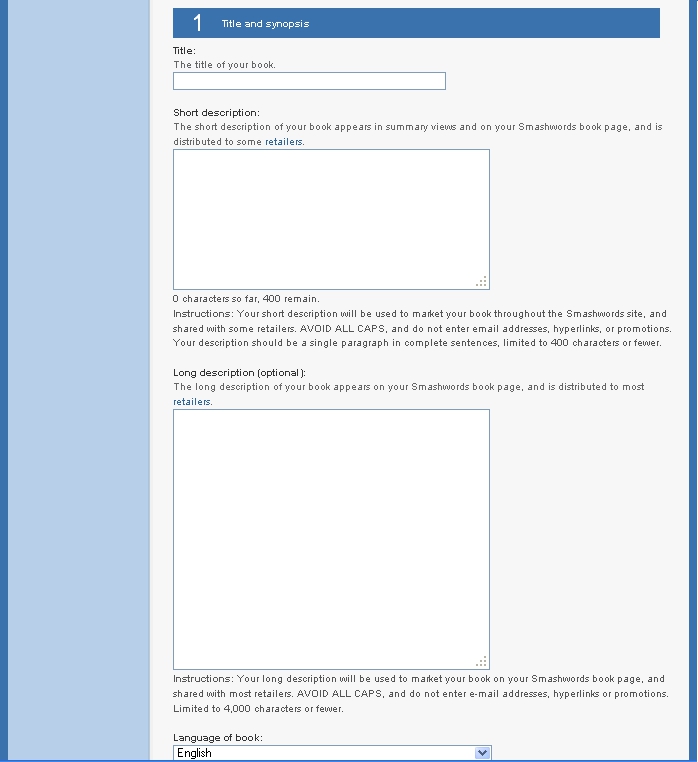
First and foremost - and I'll be speaking on these a lot in the coming days of my career, I'm sure - is a decent book cover. I admit, I've skimped for my first story. This was more or less a trial run with a short, free eBook and I don't have much money to spare. I used GIMP to create a minimalist cover with practically nothing but text.
Second, synopses. One short and one long. Short one has a 400 character limit, and the long gives you up to 4k characters of space. Even in my few browses through the eBook stores, I've depending a lot on reading these to convince me whether or not to even sample a book. Work on writing tight, engaging summaries.

Third, think of the genre you'll be categorizing it in, because you need to pick one. I had trouble with that already. I consider any story without some sort of actual science speculation as fantasy, but this story was set on a spaceship. In the end I went with the more likely public opinion: Spaceship == Sci Fi.
Fourth, think of key words to link to your eBook. Smashwords gives you the ability to 'tag' it with a few. I'm not sure of the limit; I used five or six.
There is more info to give on this page, such as pricing, the formats you want your book in, etc, but I'm sure you can figure those out on your own. If not, feel free to ask about anything in the comments.
Tuesday, December 20, 2011
...in which we second-guess ourselves
Now that the initial hectic preparation is over for my descent into the beautiful madness of ePublishing - getting a blog, a twitter, polishing up my first offerings, planning what I'll be publishing at later dates, etc - I've managed to stop and think for a second about one important question.
Am I sure I want to do this?
There have been nagging little voices all through the process, but I found it easy to ignore them due to the sheer pace. I was too damn busy for reflection. Now that I have to wait on a few things, I have the opportunity for some good, deep self-doubt. C'mon, you think the work is really that good? If this is the first stuff the public sees from you, your career is DOP! (Dead on Publication). Are you sure those 'free' stories you're planning to offer will entice readers?
To that last question - well, no. I'm not. The story I'm putting up for sale is easily the best short work I've ever done, but the other stuff - I think it's good enough. And I go back an forth on my own work enough (as I'm sure most writers do) that I can only trust the average of what I think, and what others think.
Self-Doubt is losing to good old fashioned impatience, though. I want to put myself out there. I'm tough enough to take the backlash, if it comes.
Edit: It occurred to me that in this business 'backlash' takes the form of 'deafening silence.'
Am I sure I want to do this?
There have been nagging little voices all through the process, but I found it easy to ignore them due to the sheer pace. I was too damn busy for reflection. Now that I have to wait on a few things, I have the opportunity for some good, deep self-doubt. C'mon, you think the work is really that good? If this is the first stuff the public sees from you, your career is DOP! (Dead on Publication). Are you sure those 'free' stories you're planning to offer will entice readers?
To that last question - well, no. I'm not. The story I'm putting up for sale is easily the best short work I've ever done, but the other stuff - I think it's good enough. And I go back an forth on my own work enough (as I'm sure most writers do) that I can only trust the average of what I think, and what others think.
Self-Doubt is losing to good old fashioned impatience, though. I want to put myself out there. I'm tough enough to take the backlash, if it comes.
Edit: It occurred to me that in this business 'backlash' takes the form of 'deafening silence.'
Wednesday, December 14, 2011
Launch Pad
One of the most exciting things about the prospect of ePublishing is how wide a potential audience some of my less marketable ideas might have. Provided I gain any sort of notoriety at all, someone is likely to read just about anything I put out there - which is as sobering as it is exciting, really.
If we want to make sure we're taken seriously, we have to be very careful what we put out there.
I could publish my profanity-laced short story about a war between human colonists and nano-tech driven zombies - but should I?
I could publish little back-story explorations of characters and events in my first novel - but should I?
I could even publish the little snippets of poetry that I write, two and four line things that never got beyond a clever couplet or a heartfelt question - but should I? (Does the world really need more bad poetry?)
The answer is actually quite simple - no idea is too radical, no premise too cliche, so long as the writing is good. Authors turn old tropes into fantastic new stories all the time. As usual, it's all about the writing. I just have to make sure that everything I put out there stays above a certain bar.
Which is probably why the poetry will never, ever see the light of day.
If we want to make sure we're taken seriously, we have to be very careful what we put out there.
I could publish my profanity-laced short story about a war between human colonists and nano-tech driven zombies - but should I?
I could publish little back-story explorations of characters and events in my first novel - but should I?
I could even publish the little snippets of poetry that I write, two and four line things that never got beyond a clever couplet or a heartfelt question - but should I? (Does the world really need more bad poetry?)
The answer is actually quite simple - no idea is too radical, no premise too cliche, so long as the writing is good. Authors turn old tropes into fantastic new stories all the time. As usual, it's all about the writing. I just have to make sure that everything I put out there stays above a certain bar.
Which is probably why the poetry will never, ever see the light of day.
Monday, December 12, 2011
Step One
So I've made the decision - I'm going to publish an eBook. I have the story all picked out - in fact it was the positive reception this story got from all readers that cemented the decision in my mind. Now what?
I started with research, just as I did when I had traditional publishing front and center in my brain. Where to publish, how to publish, formatting, marketing, what the prices are like these days... I read just about every article I can find on ePublishing. Soon I'll get around to devoting an entire post to what I've found.
For now, though, I've divided my foray into ePublishing into a few separate topics/concerns:
Cover Design:
I put this one first because its the one I'm least capable of handling myself. I'm not an entirely hopeless artist, but I want my books to be represent by a much better artist than myself. As soon as I'd made my decision to publish I started putting out notices to all my art-minded friends. I wanted to talk to anyone who could draw well. If I hadn't found anyone that way I was all set to start trolling deviantArt (some amazing stuff on there) and asking strangers if they'd like to help me out. Fortunately, I've found someone who was willing to take a stab at my cover.
Formatting:
eBook formatting is the arena I'm least worried about. I'm currently a computer programmer by trade, and eBook formats are generally based off of HTML/XML. No problem. My writing in the future will be set up with a mind towards making the eventual eBook conversion easier, though. No more tab-indents for me!
Marketing/Promotion:
Here's the big one. If you're thinking of publishing at all you should be thinking about how you'll build your reader base. This is more important than ever with the advent of ePublishing - it takes nothing for somebody to put their work onto the net, and not much more for them to get it onto Amazon and Smashwords. How to set yourself apart?
First step I had in mind is making sure I have a good cover. I'm guilty of buying a book based on an attractive cover (which I have definitely regretted in the past, but there it is) so I want my cover to catch the eye of anyone browsing through a page of thumbnails.
Second, active promotion. As you may have noticed, you're reading my blog - started once I was sure I was going the indie route (I had always intended to start a blog, but... well, I'm not sure I'm the natural blogging type). Somehow, I also ended up with a Twitter account - @GregoryWrites. I'll no doubt be maintaining a Google+ and Facebook author page as well. What a workload! Fortunately I already was - and long have been - an active member of some writing groups. Then comes the fun "Tell everyone I know to tell everyone they know to tell everyone...". Repeat ad nauseum. Probably my loved-one's nauseum, but I hope they'll forgive me...
Finally, to wrap up this little checklist...
Finances:
I'm gonna go ahead and bet on myself. I may not make much, but I think I can make something. Certainly enough to attract the IreS. Er, the eye of the RS. Or perhaps the ire of the IRS, should I fail to report every measly cent to 'em.
The wonderful Victoria Strauss said something along the lines of "Most authors have the financial sense of a sea cucumber." Probably true, but I intend to buck the trend. Research, research, research, even when it's boring stuff like quarterly tax reporting and special cases for income earned on book sales...
I started with research, just as I did when I had traditional publishing front and center in my brain. Where to publish, how to publish, formatting, marketing, what the prices are like these days... I read just about every article I can find on ePublishing. Soon I'll get around to devoting an entire post to what I've found.
For now, though, I've divided my foray into ePublishing into a few separate topics/concerns:
Cover Design:
I put this one first because its the one I'm least capable of handling myself. I'm not an entirely hopeless artist, but I want my books to be represent by a much better artist than myself. As soon as I'd made my decision to publish I started putting out notices to all my art-minded friends. I wanted to talk to anyone who could draw well. If I hadn't found anyone that way I was all set to start trolling deviantArt (some amazing stuff on there) and asking strangers if they'd like to help me out. Fortunately, I've found someone who was willing to take a stab at my cover.
Formatting:
eBook formatting is the arena I'm least worried about. I'm currently a computer programmer by trade, and eBook formats are generally based off of HTML/XML. No problem. My writing in the future will be set up with a mind towards making the eventual eBook conversion easier, though. No more tab-indents for me!
Marketing/Promotion:
Here's the big one. If you're thinking of publishing at all you should be thinking about how you'll build your reader base. This is more important than ever with the advent of ePublishing - it takes nothing for somebody to put their work onto the net, and not much more for them to get it onto Amazon and Smashwords. How to set yourself apart?
First step I had in mind is making sure I have a good cover. I'm guilty of buying a book based on an attractive cover (which I have definitely regretted in the past, but there it is) so I want my cover to catch the eye of anyone browsing through a page of thumbnails.
Second, active promotion. As you may have noticed, you're reading my blog - started once I was sure I was going the indie route (I had always intended to start a blog, but... well, I'm not sure I'm the natural blogging type). Somehow, I also ended up with a Twitter account - @GregoryWrites. I'll no doubt be maintaining a Google+ and Facebook author page as well. What a workload! Fortunately I already was - and long have been - an active member of some writing groups. Then comes the fun "Tell everyone I know to tell everyone they know to tell everyone...". Repeat ad nauseum. Probably my loved-one's nauseum, but I hope they'll forgive me...
Finally, to wrap up this little checklist...
Finances:
I'm gonna go ahead and bet on myself. I may not make much, but I think I can make something. Certainly enough to attract the IreS. Er, the eye of the RS. Or perhaps the ire of the IRS, should I fail to report every measly cent to 'em.
The wonderful Victoria Strauss said something along the lines of "Most authors have the financial sense of a sea cucumber." Probably true, but I intend to buck the trend. Research, research, research, even when it's boring stuff like quarterly tax reporting and special cases for income earned on book sales...
Sunday, December 11, 2011
So it begins
I've been writing as long as I can remember, but it was only in high school that it occurred to me - due to the words of a friendly creative writing teacher - that other people might want to read my stories. Since then, I've had publishing on the mind.
I had the usual dream: Write novel, amaze agent, get contract, enjoy fame. Fortunately I'm a realist, and never held any illusions as to the likeliness of this dream coming true. I knew the odds were against me making it big. When I presented that fact in all its sobering glory to my conscious mind, the answer I greeted it with surprised even me.
"Who cares?" I replied to myself. "I just want some people to read my work."
It's an important realization, I think. If you can't be realistic about your chances you're all to likely to become disappointed and disillusioned with the long slow slog. So I humbled my dreams. I'd love to make it big - who wouldn't? - but my goal is just to get my work out there where people might enjoy it. Maybe I'll even earn something. For a long time this meant putting my shoulder to the wheel with my writing and trying to find an agent.
Then ePublishing comes along.
At the beginning of the year I looked at the possibility of self-publishing my book or some of my shorts as eBooks, and decided against it. Not ready, too small, too filled with dross. Here we are only eight, maybe nine months later, and I've changed my mind.
My, how the publishing world has changed in such a short time. eBooks are rapidly gaining in popularity, there are more and more channels to market and display your work, and most importantly - the up-front costs are the same as traditional publishing. (None).
I'm still hoping to publish my first novel traditionally, but I'm rapidly warming to the idea of ePublishing it. For now, though, I'll test the waters with other work. It's exciting to watch industry change - I just hope I can keep up with it!
I had the usual dream: Write novel, amaze agent, get contract, enjoy fame. Fortunately I'm a realist, and never held any illusions as to the likeliness of this dream coming true. I knew the odds were against me making it big. When I presented that fact in all its sobering glory to my conscious mind, the answer I greeted it with surprised even me.
"Who cares?" I replied to myself. "I just want some people to read my work."
It's an important realization, I think. If you can't be realistic about your chances you're all to likely to become disappointed and disillusioned with the long slow slog. So I humbled my dreams. I'd love to make it big - who wouldn't? - but my goal is just to get my work out there where people might enjoy it. Maybe I'll even earn something. For a long time this meant putting my shoulder to the wheel with my writing and trying to find an agent.
Then ePublishing comes along.
At the beginning of the year I looked at the possibility of self-publishing my book or some of my shorts as eBooks, and decided against it. Not ready, too small, too filled with dross. Here we are only eight, maybe nine months later, and I've changed my mind.
My, how the publishing world has changed in such a short time. eBooks are rapidly gaining in popularity, there are more and more channels to market and display your work, and most importantly - the up-front costs are the same as traditional publishing. (None).
I'm still hoping to publish my first novel traditionally, but I'm rapidly warming to the idea of ePublishing it. For now, though, I'll test the waters with other work. It's exciting to watch industry change - I just hope I can keep up with it!
Subscribe to:
Posts (Atom)